
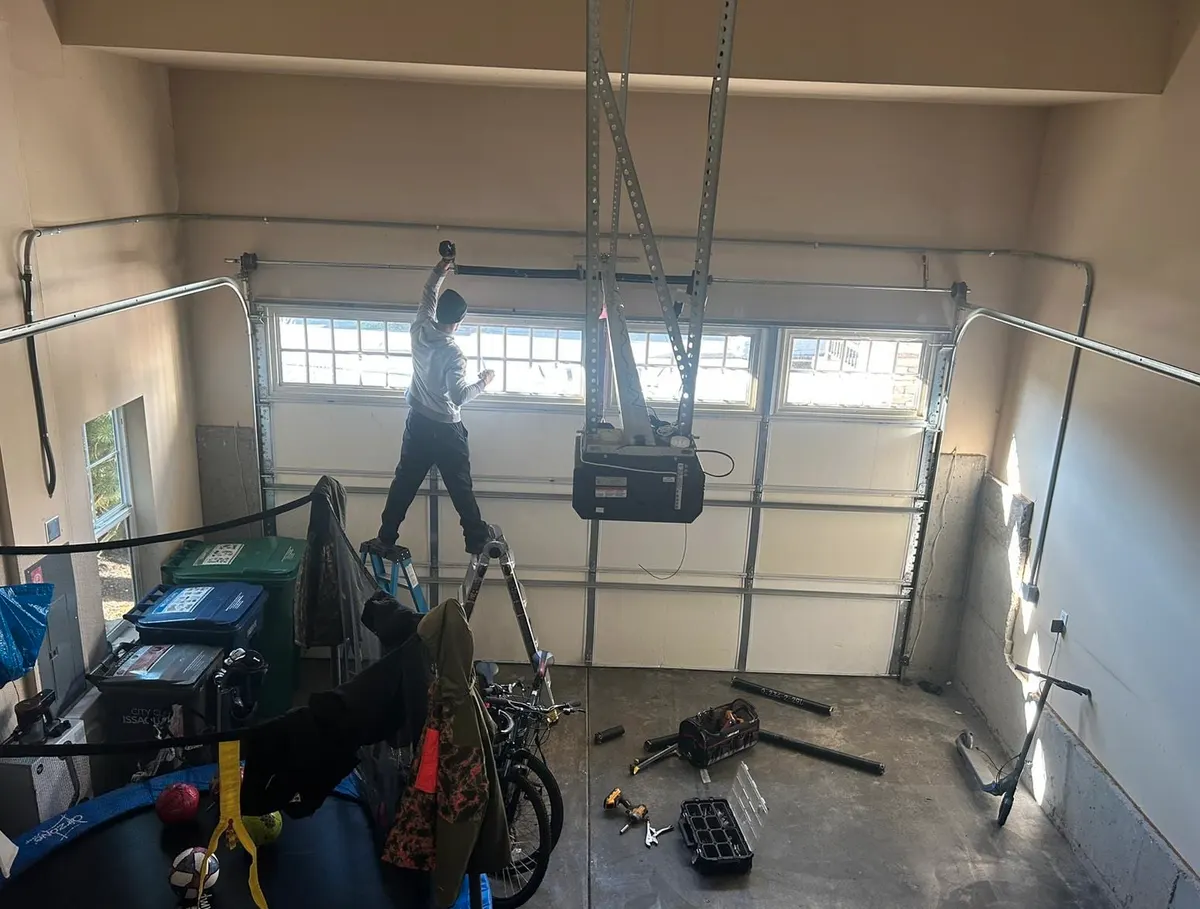
What a Technician Sees on These Calls
A homeowner calls because the opener "sounds like it's working harder than it used to." Maybe the chain grinds, the door hesitates halfway up, or the remote only works every other try. Nine times out of ten, the opener itself is fine. The real problem is that the springs are no longer carrying their share of the door's weight, so the motor has been quietly doing a job it was never built to do. By the time someone notices, the opener has already been overworking for months.
What an Unbalanced Door Does to the Opener
A properly balanced garage door should feel almost weightless when lifted by hand, because the springs are counteracting nearly all of its weight. The opener's motor is only designed to provide the final push — not to haul the door up on its own. When springs weaken from age, temperature swings, or wear, the opener has to pick up the slack every single cycle.
Over time this shows up as:
- A chain or belt that strains, slaps, or sags
- Gears inside the opener unit wearing out faster than they should
- The door reversing partway up or down as the unit senses resistance
- A motor that runs hot or trips its own safety shutoff
- Shortened lifespan of the opener overall, sometimes by years
Local conditions make this worse. Winter rain can add moisture weight to wood-paneled doors, cold mornings tighten and stiffen spring coils so they don't flex the way they should, and dust from the dry season builds up in tracks and hinges, adding friction that masks how far off balance the door really is. An opener fighting all of that at once fails faster than one on a well-balanced door.
Tools You'll Need
- A sturdy step ladder
- Work gloves
- A helper is useful but not required
- Nothing else — no wrenches, no spring tools, for this test
How to Test Garage Door Balance
- Close the door completely. Start from a fully closed position so you're testing the whole range of travel.
- Find the manual release. This is the red cord hanging from the trolley on the opener rail. Pull it to disconnect the door from the opener. You should hear or feel it release.
- Lift the door by hand to about waist height. Use both hands and go slowly. Note how much effort it takes — it should feel light, not like dead weight.
- Let go and watch what happens. A well-balanced door will stay roughly in place, or drift down just a few inches on its own. A door that's out of balance will either slam down or spring upward on its own — both are signs the springs aren't matched to the door's weight anymore.
- Repeat the test at two or three different heights. Try it near fully open and again near fully closed. Some doors are balanced at one point in their travel and badly off at another, especially with torsion spring setups.
- Reconnect the opener properly by pulling the release arm back until it clicks into the trolley, then run the door through one full cycle with the opener to confirm it reconnected correctly before using it normally.
What You Can Safely Do
Everything above is safe for a homeowner: disconnecting the manual release, lifting by hand, and observing. If the door holds position smoothly at every point you tested, your balance is fine and the opener issue likely lies elsewhere.
What Needs a Technician
If the door drops, jumps, or feels noticeably heavier at one point than another, stop there. Adjusting spring tension, re-winding torsion springs, or repositioning cable drums involves parts under extreme tension that can cause serious injury if handled without the right bars and clamps. This is not a tutorial moment — it's a call-a-professional moment.
When to Call Tehachapi Garage Door Co
If your balance test shows the door isn't holding steady, or if you'd rather skip the ladder work altogether, that's exactly the kind of visit our Garage Door Maintenance service covers — we check spring tension, cables, and hardware as a set, not in isolation. If the springs themselves are worn out or mismatched to the door's weight, we handle that through our Spring Replacement service with the proper tools and tension gauges, so the opener goes back to doing only the job it was designed for.
If you're anywhere in Tehachapi, Bear Valley Springs, Stallion Springs, Golden Hills, Keene, Mojave, California City, or Rosamond and your door doesn't pass this test, give Tehachapi Garage Door Co a call — we'll come take a look and get the balance right before it costs you an opener.